
The Sappy Beginning: introducing “On loop”
a series of (un)fortunate events

It’s my birthday and I watched I Used To Be Funny (2024) yesterday. I’m dying for a rewatch. I’m listening to Michelle Tea’s book about trying to get herself pregnant for the second time, because it feels fitting to revisit a beloved book about aspiring motherhood on my cancer birthday, the most mommy sign of all astrology.
Like every other amateur genius online, I’ve decided to create a substack. Despite the fact that I’ve flopped in basically every previous attempt at routinely and consistently writing and then sharing that writing—Bindery book review newsletters, The Lavender Menace’s substack, various new year resolutions for the past over a decade of my life—here I am! In spite of the fact that I’m working against a video-essay dominated, deeply oversaturated online cultural commentary space, I am insisting on producing written text. And I hope there’s some appeal here for my rubbernecking audience that misses my messy online presence.
I love art and media of all forms. Regardless if it’s music or literature or film or sculpture or ballet or video game design, I am enamored with the creative vision and processes required of creators. On youtube and among my friends and those who know me, I think I am considered “the one who reads a lot of books” or some sort of contemporary fiction expert. Which is a very honorable reputation and one I try to live up to. On the podcast substack, I’ve published book-reviewish essays, and I’ve written one public post on my bindery that contains full-length, probably way-too-long reviews of the first five or so books I read in 2024. And while my goal is to continue publishing on the substack I share with Renaissance and my bindery page, I wanted this specific forum of my online world to contain a less limited vision of things I want to write about, a less book-specific publication that was under my name only. I hope that’s reasonable and not overkill.
Armed with my love of writing sentences over three lines long and parenthesis, I hope this writing project will suffice as perhaps recompense for my now non-existent and at-the-time quite controversial (another future essay to expand upon) Internet presences on tik tok and twitter. If any of you who are reading remember those notorious eras of my online life, I appreciate you greatly!!! I’m endlessly grateful for every and any person reading this silly introductory post to On loop right now. It is through that gratefulness that I am putting my acknowledgements at the beginning of this essay. Conventionally, books have the acknowledgements sections at the end. But it’s my substack and I’ll do what I want to! Starting from the very beginning.
I. Thank you, thank you, and thank you
I’m not sure if my attempt at contributing to the rich landscape of contemporary nonfiction writing online will reach many people, but I hang on to the memories of my friends’ direct encouragement of me and my writing. From Ida telling me that reading my writing is a privilege/treat/delight, to Maimoonah’s coffee stand compliment of my cultish communism essay I published in 2021 on The Lavender Menace substack, I hold these comments dear and close to my heart. I still think about Maimoonah praising me (undeservedly, for the most part) for that essay that is perhaps, looking back, likely quite amateur and a naïve piece. Yet I was and still am so proud of it!! And of course, it would be remiss to not acknowledge my one and only editor for that essay.
I hang on to the endless laughter and support and editorial assistance that Renaissance, my best friend, so generously offers me. I owe Renaissance more than I can express—for their steadfastness by my side as I went through some of the worst and lowest points in my life, for celebrating my high points, and for telling me nearly every goddamn day that I should not kill myself. Renaissance tells me that my writing and my work is important and impressive and worth the effort, always. I trust their judgment endlessly; Renaissance remains one of the harshest critics of contemporary media I have ever encountered.
For everyone reading this right now—thank you for being here. And thank you to my friends and mutuals whose own substacks inspired me to create On loop. Tayo, Kennedy, K, Jess, Rayne—I admire you all so much. I’m in absolute awe of your brilliance. Your intelligence and vulnerability have all deeply inspired and motivated my writing. Enrique, thank you for telling me over a year ago at this point that I should start my own substack. Here it is! Diya, you’ve been making me laugh and impressing me with your poetry since we were both 15. Thank you for being my butch cancer sun counterpart, and thank you for always pushing for me to write. Yujin, thank you for telling your friends that I’m a good writer and letting me cry on the phone to you. Matt and Burke, here’s to every weekend in high school we spent together going to the movies as I got canceled by our classmates on instagram.
For my former professors whom I cherish so deeply and who are most likely not reading this right now—thank you for making my writing and thinking sharper, smarter, and more sophisticated. I know I’ve already thanked you both in my thesis acknowledgements in my cheesy cancer way, but Ian—your laugh brightens my day, my whole week even. I’m intimidated by how much you know, and how well you communicate it in your teaching and work. Marilyn, you are like a mother to me, or a favorite aunt at the very least. I love hearing about your life, and I hold dear in my memory all the silly things you told me as I sat in your office petting Bear. Thank you for telling me that my best work as a writer is as a reviewer; it’s inspired the existence of On loop. Ryan Quintana, thank you for telling me after my thesis defense committee that my writing is worth reading. Multiple of my Wellesley alum friends who graduated before 2020 recall Professor Quintana as a favorite professor, and Marilyn gets sent books written by her former students with signed notes inside. You are all such accomplished people and I admire you all so greatly!
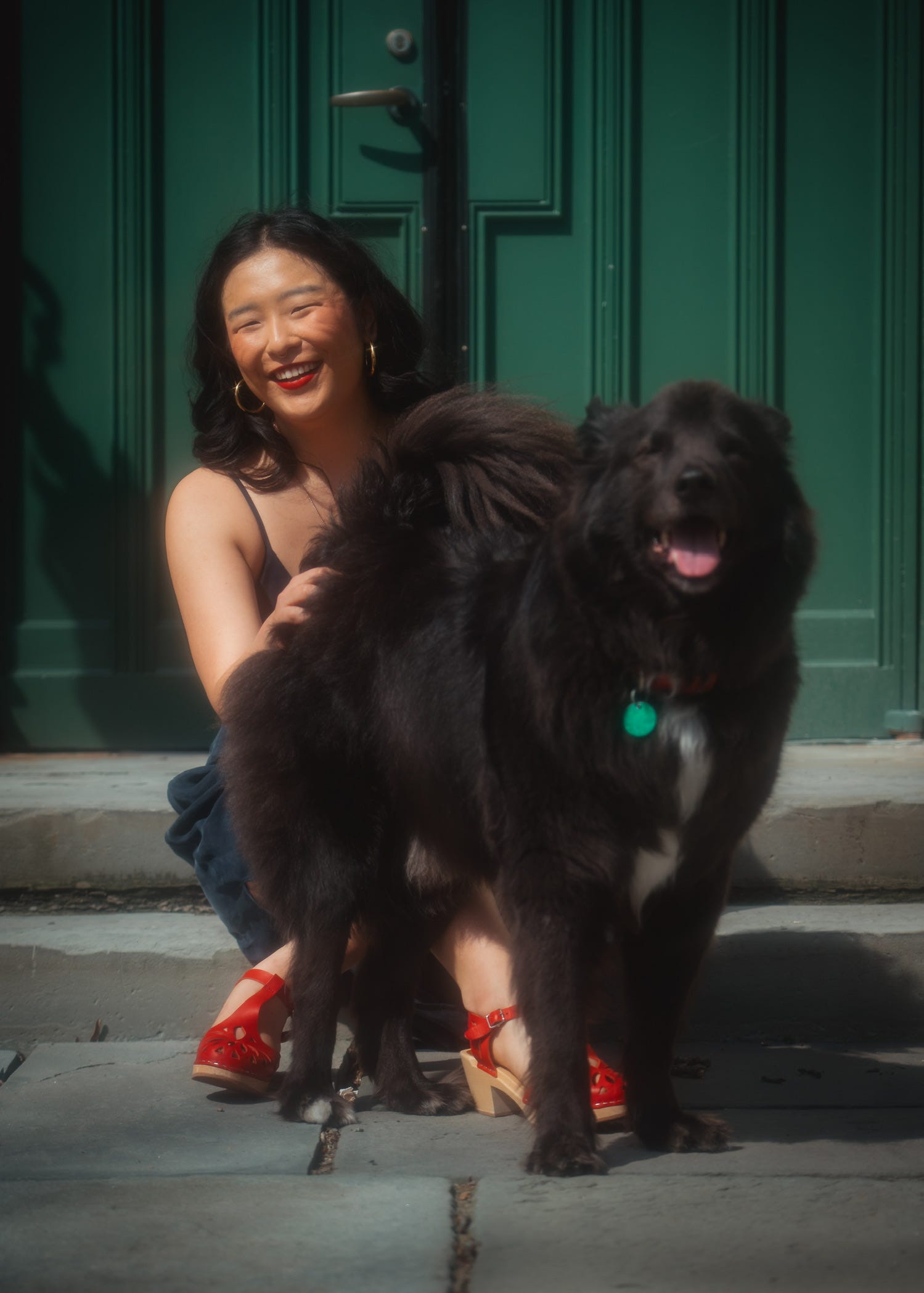
Me and Bear.
The women of the Wellesley English department whose pedagogy have expanded my mind in ways I couldn’t have conceived of before I entered your classrooms— Yoon Sun Lee, Kate Brogan, Kathryn Winner, and of course, Marilyn— your humor and advice and encouragement of me, even as I routinely babbled in your presence, lives vibrantly in my memory. Your words buoy me, even as I continue to feel embarrassed by all my missteps fumbles I’ve made in your presences. English professors have mastered the art of at once being very intimidating and deeply approachable.
None of these incredible professors in my life could have known this at the time, but there were days where I seriously considered suicide and brainstormed every potential way I could easily end my life, only to remember that I had their classes to look forward to. Yes, it was that serious and melodramatic! And yes, it often still is. Sometimes being a massive nerd who insists on being a pain in the ass during class discussions forces you to live at least one more day.
Now that I have gotten all the mushy gushy stuff out of the way, let’s turn to the why and how and what that you can expect with my substack.
II. Why “On loop”???
I’m calling this substack On loop as a reflection of my habits in how I approach art. Like probably everyone else on Earth, my brain simmers with all that I’ve read, watched, and experienced. Of course, reading and watching as processes are themselves experiences, and I hope to speak more about this in my upcoming audiobook essay. I’ve had the idea of my defense of audiobooks essay rooted in my mind for over a year now, inspired by both longstanding bookish online discourse about what constitutes “real reading” and some knowledge I don’t think enough people possess.
In our 2023 media review episode of the podcast, Renaissance and I compare our spotify listening stats (the phenomenon of the automated tracking of one’s music listening habits down to the exact number of plays of songs and albums is itself worth an essay I think), and it turns out that I listened to significantly more minutes of music than Renaissance did in the year, but one thousand fewer songs. That’s what I mean when I talk about listening to songs on loop; I’m monogamously committed.
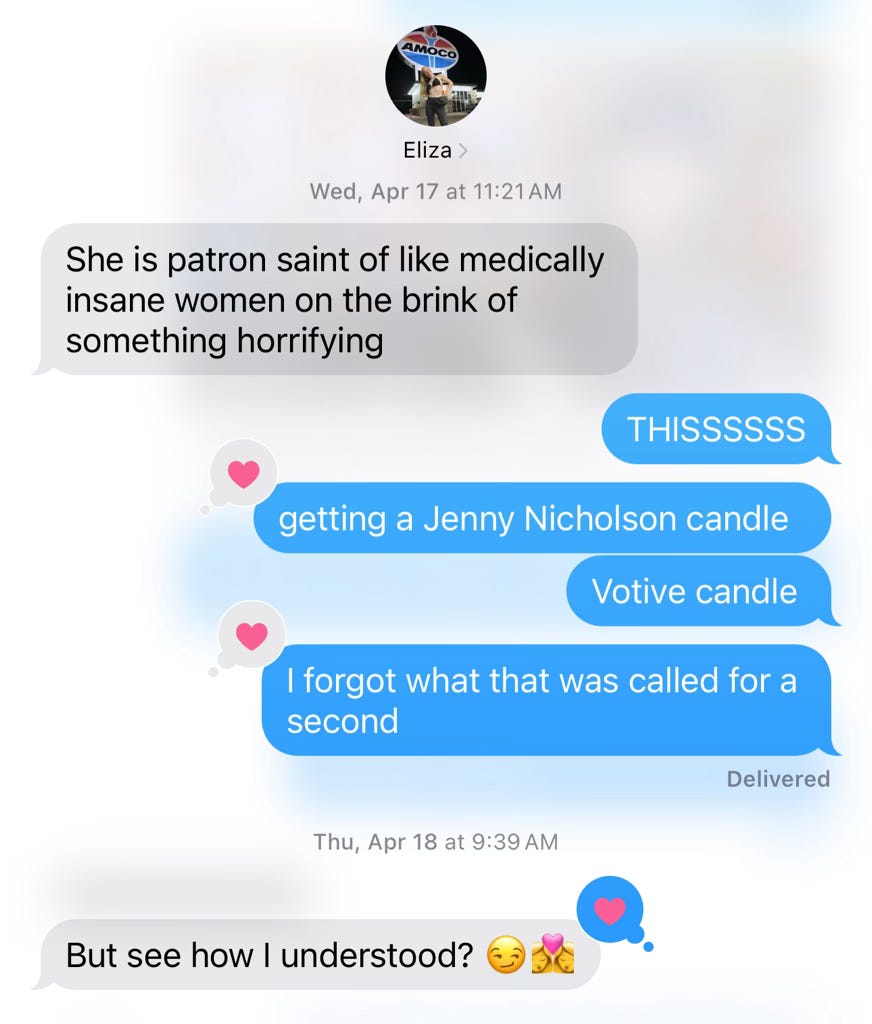
That’s likely a fairly conventional and statistically likely situation of spotify listening habits. And perhaps so are my perpetually on loop media consumption habits that stretch across mediums and form. There are certain Jenny Nicholson videos that I have watched before bed every single night for weeks on end. For a couple months in my senior year of college, I fell asleep watching her vampire diaries video every single consecutive night. I’m half listening to a Jenny Nicholson patreon video right now as I am writing this, and I’ve fallen asleep to this particular video maybe every night since its release. This is actually my second consecutive watch of this video tonight, because I wasn’t done writing by the time the video ended the first time around. Like Eliza (my one and only hetero best friend from high school who makes me laugh like no one else) said, Jenny Nicholson is “the patron saint of like medically insane women on the brink of something horrifying.”
Speaking of high school, there were particular video essays (the massive rise in popularity of that format of disseminating and engaging with ideas is worth its own essay, or maybe even video essay, in my opinion) I would watch on loop for months on end. Specifically, nerdwriter01’s ELEMENT video, his Truman show video (although the political extremism comment about Bernie vs trump is veryyyyy unserious but what can you expect from a liberal white man offering his opinion on media online), and lessons from the screenplay’s gone girl video have all burrowed in my mind and never left. While videos essays were my bread and butter for a long time, I’ve lifted myself out of that world since around 2021 I think, mostly because I just became less and less interested in the content. Also, I would put them on in the background while painting with gouache and I stopped having the time or energy for painting by around 2022. Yet another hobby I need to pick back up…
III. Books on loop…?
With regard to books as media, I think the on-loop nature of my reading habits exists differently than with my youtube and spotify habits. I’m not one to frequently reread books, partially because of the more time-consuming nature of reading compared to watching films or listening to songs. I want to read as widely within my range of enjoyment and/or worthwhile criticism as possible, and I simply don’t have much interest in revisiting books without specific intentions.
I’ve read over a thousand books in my life; I’m getting this number from what I’ve logged on Goodreads, which I’ve used on and off again since maybe 2016. But I’ve religiously updated my Goodreads since my early booktube days, just to keep track of my reading and have a public logbook of things I’ve read without having to put in more effort than opening an app on my phone, which is an activity I’m going to do no matter what. And of the hundreds of books among the 1000+ I’ve read that I’ve very much enjoyed, I only remember rereading less than a dozen books cover to cover:
Aristotle and Dante Discover the Secrets of the Universe, Benjamin Alire Saenz. A young adult novel that I read in high school or maybe middle school that irreversibly changed me, I think. The type of novel that I encountered at the exact right time in my life, the queer young adult contemporary story doing its job perfectly. I vividly remember rereading the paperback cover to cover one night, years after I first read the loved the novel. It was late, a school night, and I hadn’t anticipated reading a book that night. I randomly picked it up, started reading, and something within me compulsively kept reading until before I knew it, I had finished the novel.
The Hike, Drew Magary. I just couldn’t get this one out of my head after reading it. I had to revisit the weirdness of this literalized hero’s journey—the talking crab, the vicious dog chase, the roads not taken…! Also, the audiobook is fantastic and I was addicted to the narrator’s voice telling this story. It was compelling, memorable, compulsively listenable, and my itch to revisit the story weeks or months after I had first read it was palpable and also unique. I have not experienced a desire for a reread like this one since.
Fortune Favors the Dead, Stephen Spotswood. Another audiobook that I was so delighted with that I simply had to reread it!! Or “relisten” to, whatever. After I finished this novel, I simply had to replay it from the very beginning. There was something about this somewhat goofy, semi-noir 1940s world and sense of humor that the main character possessed that just stuck in my head in that moment. I replayed the audiobook within days of first finishing it, and was as delighted with it on reread as with my first encounter.
The Broken Earth, N.K. Jemisin. I reread this book for Marilyn’s class and loved it even more on my reread. I got to approach the book fully knowing all the twists and reveals, and thus pick up on all the perfectly written hints and clues leading up to them. I got to truly and purely appreciate the craft of Jemisin’s writing, witness my classmates’ responses to it as they encountered the novel for the first time, and unpack so much about the book that I hadn’t previously understood. I love English class!!
Passing, Nella Larsen. I read this at the beginning of the pandemic simply because it was a short book that I had bought, and being a Harlem Renaissance sleeper hit, I was interested. My favorite podcast (actually the only podcast I listen to; which might be weird considering I have my own podcast but), The Bookstore hosted by Corrinne and Becca, featured it in one of their episodes around this time as well I think. But I reread Passing simply because it appeared on the syllabus of one of my classes, Sapphic Modernism. Which despite the compelling title and contents of the course, was kind of miserable due to the fact that the lesbians who take such English classes are annoying.
White is For Witching, Helen Oyeyemi. I first read this book for Marilyn’s class, and then reread it for another one of Marilyn’s classes. It’s a dense book that’s quite thinky for a contemporary novel, full of literary allusions and ideas that are very fun to interrogate in a classroom setting. My first read was a bit of a struggle, but the second read was more enjoyable because I knew there was so much to unpack.
Severance, Ling Ma. Similarly, I read this at the beginning of the pandemic because it was beginning to get a level of hype that I was intrigued by; the cover was enticing to me as well. And similarly, as with Passing, I reread it for class. It was in Kathryn Winner’s class that I came to understand and appreciate this novel in a different way than as a story to be enjoyed, but also as a book that is packed full of object specificity. I ended up writing a paper about this book in relation to the next book on this list, which I reference in my Spring 2024 wrap up video, and will likely post onto On loop in the near future! I liked this book more the second time around specifically because I was reading it in a class that I really enjoyed, and was talking about it with people who both challenged and supported my opinions and readings of books.
Annihilation, Jeff Vandermeer. This was a bit of a booktube darling for a moment, and I was intrigued. Again, I reread this book for Kathryn’s class, and enjoyed it far more on the critical reread. Gender and biology and climate change and all that!
Y/N, Esther Yi. Another reread for Kathryn’s class! I’ll mention here that the class in question was “Genres of Contemporary American Literature.” Hence I was barricade at the registration for this course. This book I found as offputting upon reread as on my initial read. I don’t have much to say about it beside the fact that it makes me laugh that this was the book that ended up at the end of the syllabus, after much contemplation about what the “romance book” for the class was going to be. Colleen Hoover? Too shitty. Sally Rooney? Not American. Esther Yi? Debut novelist and likely a complete weirdo freak. So of course, Yi’s book was the only feasible option.
If I’ve reread any books that aren’t on the above list, then my memory has failed me. But I think I have a pretty sticky memory when it comes to books.
Rather than rereading books cover to cover, I’m more into if and how those books marinate in my mind. How often am I thinking about the ideas those books articulated in my day to day life? How often do I want to bring up a title when I’m talking about specific topics? There’ve been many times in my life where I’ve tried to explain something related to memory, time, and technology, the exact concept and idea of which is perfectly expressed in the Ted Chiang science-fiction short story “The Truth of Fact, The Truth of Feeling.” On the other hand, when you get in a social situation where you’ve happened to read the same science-fiction fantasy novel as someone else that you get to gush about—that’s a magical feeling. There’s something special about a book existing on loop for me in that way. I can never unread a book, take back the four hours or four months I spent reading it. The ideas books present change me as they touch me.
Once, I argued with anarchists at a party about Octavia E. Butler’s Parable of the Sower and its fictitious religion of Earthseed. One particular person spoke to how they believed in and lived by the Earthseed verse “God is change,” and I can only imagine what they’d think about the second book in that trilogy where Lauren’s daughter provides clarity on the shortfalls of Earthseed as she reads through her mother’s journals, the very journals that constitute the first novel in the series.
Then, there are the nonfiction books that exist in my mind on loop, that I always reference and think of when encountering other books, new stories, the latest hot takes online. Essay collections like Trick Mirror by Jia Tolentino, The Hard Crowd by Rachel Kusher, and Some of My Best Friends by Tajja Isen all exist on loop for me. I will be referencing these books in future essays, trust! Isen’s piece on the politics of sad white women’s art, Tolentino’s iconic “Always Be Optimizing,” Kushner’s reminiscences on Lispector—this is the type of writing that makes me want to write, to think, to talk with people about. Not to mention, there’s Michelle Tea’s books. Michelle Tea! You mother, you icon. She doesn’t need my praise, since she has Eileen Myles’ and Allison Bechdel’s, but it’s just true that her writing simmers with queer joy and feminist rage while living in the gritty shit, the pain, the nonsense of it all. At the same time, I can’t write that without thinking of her essay in Against Memoir where she talks about nurturing young female writers writing about their pain and their trauma, one after the other, and the overwhelming tiresomeness of it all at a certain point. I can only hope that nothing I write, no matter how personal or impersonal, reaches redundancy.
IV. More on books and the Internet
I hope some of you caught my A Series of Unfortunate Events reference in the title of this very long introductory post. (Caelan, my genius friend, I know you’d appreciate this! Thank you for all your support and encouragement through everything. I cherish your unwavering belief in my capabilities and intelligence.) My allusion to The Bad Beginning by Lemony Snicket works respective to my memories of second or third grade, when my teacher read aloud chapters of this series to us. We sat on the colorful rug at her feet, mouths dangling open as we listened raptly. Or at least, I was paying rapt attention. Encountering this series was the first time I had ever read a character in a novel who had the same name as me, and it made my seven-year-old self feel very special. My experience of gathering with my fellow itty-bitty classmates and listening to our teacher read to us The Bad Beginning: A Series of Unfortunate Events, Vol. 1 chapter by chapter out loud embodies a nearly universal early experience for humans engaging with novels—a community operation where our thoughts on the text were solicited from us as a group. I guess the bookish Internet is like an elementary school classroom in that way.
Like probably everyone else who has a booktube channel, I started it because the people in my life were annoyed at me talking to them about shit they did not care about. Just kidding! I’m sure my high school teacher whom I explained the entire plot of multiple books to really appreciated it.
At the point in my life where I began to regularly post booktube videos, I had been watching booktube for a few years. Right before the beginning of the pandemic I had finally gotten back in the habit of regularly reading, which then only escalated as the pandemic progressed.
Booktube has provided me some insight on how the Internet works in a way that I think any other ‘influencer’ can speak to. There’s the parasocial audience you foster, the potential professionalization and profitability of your hobbies, the monetization of your image and personality, the intention and care that has to go into everything you put online because whatever that you put out there exists in perpetuity, the work that goes into protecting the privacy of you, your family members, and your friends’ identities and information, and receiving an at times endless stream of strangers’ cruelty.
From firsthand experience on both sides of the equation—viewer and creator—I understand the attachment to online personas and what it involves in a way that feels intrinsic to my soul or inner child. One of the most jarring part of these worlds of social media, in circles so insular that they might as well not exist to the laypeople outside of that specific Internet subculture, is how anyone can seemingly disappear at any time. GK reads, Nicole Gallagher—where are y’all??! You were the pillars of the booktube community for hot minute. And for many girls who grew up on youtube like me, there’s the tragedy of bestdressed’s youtube disappearance. Ashley’s departure from youtube definitely marked its downfall.
For me, having deactivated my @b00kh0arder tik tok profile a few summers ago after garnering some sort of following in the aftermath of various cancellations and viral hot take videos, it’s been interesting seeing how tik tok users interact with me presently when they see my face in that familiar tik tok format again. My recent forays into making some offhand videos on the podcast page have received comments to the likes of “yay! You’re back!” “I’ve been missing seeing you on my fyp.” It makes me think about some of my favorite twitter posters who have disappeared off that app years before Elon Musk’s disastrous acquisition: bao ngo, the aforementioned K. @sheabutterfemme, among others. I myself have been permanently suspended from twitter (lol) since the beginning of 2023, if I remember correctly, and it’s been interesting to see the ongoing world of twitter discourse from my own little secret corner viewpost.
It’s impossible to engage with complex ideas in the short form, which is why it’s such a shame that it’s so much easier to read viral tweets that concisely address various contemporary issues or watch thirty second tik toks or instagram reels or youtube shorts about interesting stuff than read thoughtfully constructed articles, books, or even just watch longer youtube videos with more substance in its content than the endless algorithmically triggered scrolling of short form video apps.
On loop is part of my attempt to work against the Internet-addiction fueled constant churn of tik tok and twitter short form content by—like many of my beloved friends and mutuals—transitioning to more long form public writing over tik toks and tweets. Ultimately, my goal is for On loop to exist as an avenue for me to talk about stuff that I don’t want to express through speaking to a camera or in a conversation on the podcast, that are not purely book reviews or media analyses, where I can contribute to online discourse in the longform with a level of nuance that short videos and tweets inherently don’t possess. Let’s see how things go, On loop.
I love how personal your writing style is, it connects to my heart! I am glad you continue to try new variations of creative expression, and I am VERY glad you joined substack. Your writing is exactly what I look to read. (:
Ah Sunny I can’t wait to read more of your writing! This was wonderful. Sappy beginnings are the best kind imo (but I’m a Cancer too, so you know, I would think that)